Walk completed August 16, 2014

Sunday, June 22, 2014

June 22, 2014 -- Day 7, Eynsham to Tadpole Bridge, 15 miles

I should buy a lottery ticket, because I’m the luckiest man in the world. No, really.

Yesterday, when I checked into my room, I found there was no soap in the shower – only a soap dispenser affixed to the wall over the wash basin. So I went back to the innkeeper to ask for some soap for the shower.

“It’s not customary in this country to provide soap in the shower,” the surly innkeeper replied. “It’s customary for guests to bring their own.”

I mentioned that I during the last 3 years (LEJOG and LEJOG Revisted) I have stayed in approximately 135 U.K. hotels, inns, B&Bs, and one place called a restaurant with rooms, and every single one of them had soap in the shower. (Sometimes it’s a dispenser jar at the washbasin that can be moved into the shower, and sometimes a bar of soap as small as a poker chip, which may be wrapped in bullet proof plastic – but there’s always soap.)

She replied, “Well, you must be very lucky, because it’s not the custom in this country,” and then grudging found a soap dispenser for me.

There are something like 40 bizillion accommodations in the UK, so think how lucky I am to have stayed in only those 135 places who don’t follow the national custom. Indeed, my luck held out again today, because I’m staying in another inn that provides soap. So if anybody wants to chip in on buying a lottery ticket, I’m your guy. But don’t expect too much. My luck may be running out, because there was no hot water for the shower today – but that may also be a local custom.

Today’s walk again followed the river, passing through meadows and woods, and across locks and weirs. It was a lovely, sunny day, with perhaps a little too much humidity. For Shirley, who is following along with her map and guidebook, I did depart from the Thames Path at Bablock Hythe and walked a minor road to Northmoor to have lemonade at the pub. (Non-alcoholic -- it was too hot for alcohol while walking.) I rejoined the Thames Path at Newbridge.


The river is getting noticeable narrower as I get closer to its source. There are fewer boats on the river, and fewer walkers on the path. The only Thames Path walkers I met were John and Liz from Australia, and Dara, from Ireland. All of them started at the source.


For some reason, blogger is not letting me add captions to the pictures today. The captions, top to bottom,  would be: Narrowing River; Dara; John and Liz; Tenfoot Bridge

Reminder: Double click on any picture to enlarge.

© 2014 Ken Klug

Saturday, June 21, 2014

June 21, 2014 -- Day 6, Sutton Courtenay to Eynsham, 15 miles


Today’s quiz: Walker A leaves Abingdon at 10:00 am, following the river and walking at 2 mph, heading for Oxford, 8 miles away. Walker B leaves Abingdon at 11:00 am by riverboat traveling at 4 mph. The riverboat is 60 feet long, and Walker B spends the entire time on board pacing the length of the boat at 3 mph looking for the best photo ops. Question: Am I Walker A or Walker B?

This contest is open to all participants over the age of 18 years, except those whose names are either Larry or Daryl, who are still debating the answer to the 2011 Humber/Singer puzzle.

Hint: The correct answer is revealed in the following images:


 A delightful Saturday afternoon induced all the beautiful people of Oxford to do whatever it is that beautiful people do on a delightful Saturday afternoon. Some were content with drinking while sunning themselves on the riverbank. Some were content with drinking while sunning themselves on pub terraces overlooking the river. A few were sunning themselves in racing sculls, their hands too full of oars to hold a drink. Then there were about a dozen or so who, for reasons known only to themselves, spent their afternoon plodding along on a 7-mile footpath between Oxford and Eynsham, trying to figure out why their chosen activity was better than sunning themselves on a pub terrace.

Among the latter group were Doug and Linda, from London, who deserve congratulations for completing their final leg of the Thames path, Newbridge to Oxford, and at this very minute are probably sunning themselves on a pub terrace in Oxford while I’m writing this posting.

For some reason not now apparent to me, I’m not yet sunning mysel on a pub terrace, but that’s about to be fixed right nooowwwwwwww……


 2014 Ken Klug

Friday, June 20, 2014

June 20, 2014, Day 5, Moulsford to Sutton Courtenay, 15 miles

Jack and I had breakfast together, and then said our good-byes as he continued walking downstream and I proceeded upstream. During breakfast, Jack mentioned that when he hikes the Pacific Crest Trail during the next two years, he’s going to need an ice ax to get through the snow that will still be present at the high mountain passes. That reminded me that I have several ice axes of various sizes that I no longer use. One of the ice axes is ultra-light, which is just what Jack will need. In fact the one I have in mind is so light that it kept floating away until I had it gold plated. Of course the plating doesn’t look like gold, but Jack, trust me – it’s worth every penny that I’ll sell it to you for. Well not pennies, exactly. Dollars. Lots of dollars. Enough dollars to pay for my next trip to England. But don’t balk at the price, because it’ll make you the envy of all the other PCTers. And Jack, if your hands start turning green when you carry it, it’s not my fault. Gold does that to some people.

Early on in today’s walk, I met two ladies on the trail, Anne and Maggie, and their black Lab, Maisie, all of whom are doing the Thames Path in stages. There seem to be far more Labs in this area than I saw through the Midlands and in Scotland. I’m beginning to think that it may have something to do with the number of rivers and canals here, because Labs are water dogs. In sheep country, there seemed to be more border collies.

While walking through Wallingford, I noticed a ladies hat shop, with “Hats for sale and for hire [i.e., for rent].” For those Americans who don’t know, fancy hats are a large part of an English lady’s proper wardrobe, and are a must for formal occasions – weddings, funerals, bah mitzfah’s, coronations, etc.  This week, Windsor is hosting the Ascot horseraces, one of the premier horseraces in the country. Queen Elizabeth II attends daily, and I’ve been told that there is actual wagering on what color hat she will wear each day. From the number of yellow hats in the haberdasher’s window today, my guess is that yellow is the favorite.

Many of you may know that England had more than its usual rain last winter. Yesterday, Don Gray mentioned that the fields we crossed on the way to Pangbourne were flooded with 2 or more feet of water. Until today, all of the floodwaters on the trails I have been on have receded, and the trails were nice and dry. But not today’s trails. There were several large sections that were still extremely muddy, with standing water.

Much of today’s trails parallel the railway tracks. Trains often follow river valleys because they offer the least resistance when surveying the route.  But in England railways were typically established along waterways to directly compete with the canal companies. Eventually the railroads bought up the canal companies, an acquired their land. So as I was walking along the muddy River Thames towpath, being attacked by insects, the beautiful people were whizzing by me comfortably in air conditioned trains, sipping their tea. Knowing how sensitive the beautiful people are, I’m sure they were thinking “Oh, look at that poor man struggling through the mud. Certainly he would much rather be sitting in this comfortable, air conditioned train like me.” Perhaps they were correct.  Nah.

Jack had warned me of a temporary diversion of the Thames Path as a footbridge is replaced – possibly damaged by last winter’s floods. The diversion required several miles of road walking, including a very busy “A” road, and you know how much I like road walking. Having re-confirmed that my attractiveness among women and dogs makes me one of the beautiful people, I opted to catch the first bus that came along and skip the road walking.

Of course, that got me to my destination early, so like all highly trained probate lawyers, my first stop was at the local pub, to be followed by a visit to the church’s graveyard. At the pub, I met two Americans, Keith from Virginia and Katrina from Pennsylvania.
Katrina and Keith

 
As I was wandering around the graveyard (as I often did before retirement while handing out business cards), I was greeted by John, who triples as groundskeeper, member of the choir, and tour guide. He led me around the church showing me all the special places that only the beautiful people are entitled to see.
John

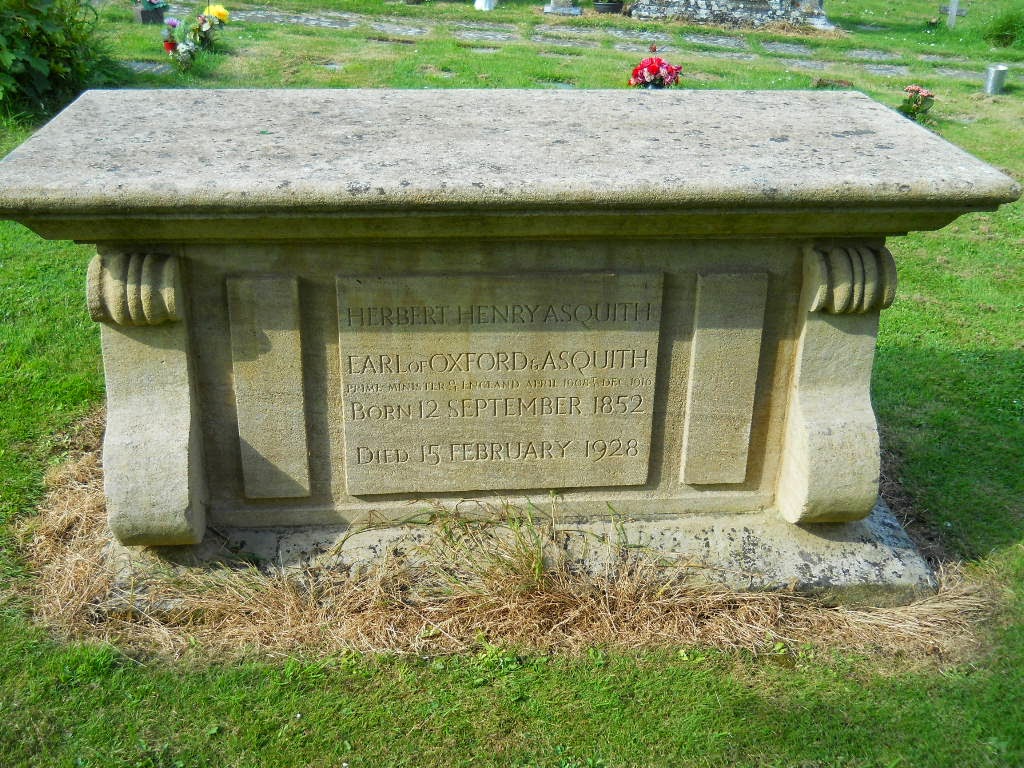
Believe it or not, several notables are buried here, including members of the Astor family (except those who went down with the Titanic); former Prime Minister Herbert Asquith and writer George Orwell (which was a pen name, his real name being Eric Arthur Blair).


Herbert Asquith's Gravesite

George Orwell Sleeps Here


As the day wore on and the sun started to set, I thought it best to remove myself from the graveyard and return to my B&B. I know the full moon was a week ago, but there’s no sense in taking chances. Oh, and maybe I’ll keep that ice ax just in case.


© 2014 Ken Klug

Thursday, June 19, 2014

June 19, 2014 -- Day 4, Reading to Moulsford, 15 miles


After checking out of my B&B, I made my way to a city park promenade along the river. I passed several runners and dog walkers, as well as people out for a morning stroll, but as is typical in a city, all eyes were averted as they passed me and my backpack. All eyes except four, that is – and it was those four eyes that convinced that today was going to be a good day.

Two of the eyes belonged to a nice lady, and two belonged to her black Lab, Pixie. The lady actually stopped me and asked where I was going, where I was from, etc. and Pixie just wanted to play, and she didn’t care that I couldn’t bend over to pick up the stick she wanted me to throw. For security reasons, I’m not including a picture of all this, so you’ll just have to believe me. But knowing I was back on the female/dog attraction list convinced me that today would be one of the good ones.

Just after passing through the village of Purley, I encountered Bruce, from South Africa, but now living in London. Bruce started walking from Dunness in the northwest corner of Scotland, about a mile from Cape Wrath. He expects to be home within the next week, but said he may not walk all the way into London. What’s the sense, anyway – he lives there.

Two miles from Pangbourne, another walker and his two dogs stopped to chat. Well, OK, the dogs didn’t want to chat, they wanted to play. All three of them then turned around and joined me for the 2-mile walk all the way to Pangbourne. The dog- walker introduced himself as Don – Don Gray. Of course I did a double-take, because those of you who followed My 1200 Mile Summer blog may remember that Don Gray intercepted me south of Bristol and walked with me all the way to the Severn Bridge. It turned out that Don Gray number 2 isn’t the same Don Gray who met me three years ago, but the coincidence was startling. In any event it was fun to have three companions for a good part of the morning, and it took my mind off my sore knees for a while.

Some of today’s walk was through pretty countryside on nicely maintained trails, undulating through woods, at times high above the river and at times along the river, where I passed several pill boxes left over from WWII.

Nearing Goring, I met Arendo and Pauline, from the Netherlands, who mentioned to me that Jack Frost had arrived at the hotel, and had warned them that they might see me on the trail. Arendo and Pauline have been walking from the Thames source, so even Jack’s warning wasn’t enough to keep them out of my blog.

Closer to Goring, I tripped over a tree root on the trail. Fortunately, I didn’t plunge into the river. Unfortunately, I went down hard. Fortunately, stinging nettles cushioned my fall. Unfortunately, there’s a reason they are called stinging nettles. Fortunately, I was able to avoid a face-plant. Unfortunately, I landed on my shoulder. Fortunately, I didn’t break anything. Unfortunately, I don’t yet have a reason to abort this silly walk.

I arrived at the hotel, muddied but not bloodied. My clothes and I both had a proper cleaning, and I was presentable enough to meet Jack Frost. Those of you who followed My 1200 mile summer blog will remember that Jack is from Yuma, and he walked from Land’s End to John O’Groats two weeks ahead of me. We’ve been emailing each other for several years (since before we did our LEJOGs), but never had the opportunity to meet. It just so happens that Jack started walking the Thames Path from the source last week. Since I’m walking in the opposite direction, it was inevitable that we would meet. I’m even pretty sure that the Jack Frost I had dinner with tonight is the same one I followed on LEJOG.

I just knew today was going to be a good day. 
 
PS: Double click on any picture to enlarge it.


© 2014 Ken Klug


Wednesday, June 18, 2014

June 18, 2014 -- Day 3, Marlow to Reading, 17 miles


I’ve known for a long time that today would be a difficult day – 17 miles on my third walking day, before my body has been acclimated to long walks with a heavy pack. But when I woke up today with stiff knees and sore shoulders, I realized that the day was going to be more difficult than I expected.

The guidebook divides today’s walk into two different sections, Marlow to Henley-on-Thames (8½  miles) and Henley to Reading (9 miles). For psychological reasons, I rounded it down to 17 miles, but the guidebook’s mileage didn’t include the distances between the path and the B&Bs at both ends.

By the time I reached Hurley (2 miles from Marlow), I was hurting. My pack felt heavier than it ever had; I’m sure I was bent over like an old man. I decided I could push myself to Henley, and then take a bus or train to Reading. Of course, I might not even get to Henley if the footpath was blocked.

As I proceeded upriver, I began leaving urbanity and moving into more countryside. The scenery grew increasingly pleasant, but it didn’t help my legs or shoulders.

 
At the Hambleden Lock, I met Geoff and Anita, from York, who are staying at a local caravan (camper) site, and bicycled to the lock. We had a nice discussion, which gave my legs a rest, but did nothing for my shoulders.

 
Farther upriver, I passed several crew teams rowing their shells. Henley is hosting the Henley Regatta this weekend, and female crew teams from all over the world are practicing. Most of you know that females are usually attracted to me, but these strong, college-age women were not attracted to a bent-over old man struggling to place one foot in front of the other.
 

A little while later, I came upon two Labs, Max and Pi, who were intent on retrieving toys thrown into the river. They sniffed at my feet, but when I couldn’t reach down to pick up their toys and toss them in the river, they quickly lost interest. You know it’s a bad day when both women and dogs ignore you.

Nearing Henley, I passed by Rob, a U.S. Marine from Virginia. Or more properly, Rob passed by me – three times – as he ran back and forth along the towpath approaching Henley. Rob just completed a coast to coast bicycle trip across the U.S. He inspired me. Suddenly my legs ached less, and my pack weighed less, and I walked a little taller all the way to Reading.

Rob, if you are reading this, thank you very much – not only for all that you’ve done, but also for all that you are doing. You are a hero!!


© 2014 Ken Klug

Tuesday, June 17, 2014

June 17, 2014 Day 2 -- Monkey Island to Marlow, 12 miles

Despite a reasonable search, I was unable to find any monkeys on Monkey Island. There were several
resident peacocks, however, and they screeched all night pretending to be monkeys. If I were the manager of the hotel, I would please all the guests by serving roast peacock at the next holiday dinner.

Perhaps there once were monkeys on the island, but if so it was a long time ago. In 1738, the third Duke of Marlborough decorated the ceiling of his fishing lodge with images monkeys engaged in outdoor human recreation –boating, fishing, hunting. Nobody seems to know what motivated the Duke to paint monkeys, but I suspect that he just painted over images of peacocks. In any event, the hotel has been in business since 1840, so it’s probably seen many generations of peacocks, and the current ones think they own the place.

Today turned out to be dry and sunny, and the scenery was much more vibrant than yesterday. Most of the scenery consisted of large mansions fronting on the Thames, hidden only by their accompanying yachts. The path, itself, follows the riverbank, generally passing through lovely private gardens and manicured lawns. Originally the footpath followed the historic towpath, but in more recent decades, portions were relocated from one side of the river to the other, probably depending on which group of wealthy residents had the most influence with the local authorities.

Large watercraft are still navigating the river, whose current is controlled by strategic use of weirs that converted a free flowing river with sections of rapids into a pool and drop river with long sections  of flat water. Boats use locks to ascend or descend from one pool to the next.

Graham
At Bray Lock, I noticed two swans accompanying a boat through the lock. When I asked the volunteer lock keeper, Graham, if he operates the lock for the swans as well as for boats, he chuckled, remarking that the swans have learned that if they follow a boat into the lock, the can move upstream or down without having to fly over the weir.


Robert
Most of the walkers I encountered today were either dog walkers (I’m still in a heavily populated area near London), or day hikers. I did meet my first Thames Path through-walker, Robert, who lives near Exmoor and started at the Thames Source only five days ago. He’s carrying a large pack, and is camping along the way. Maybe I should consider camping, because he didn’t mention anything about peacocks.


m


© 2014 Ken Klug

June 16, 2014 Day 1 -- Adventures in Wonderland -- 10 Miles


Leaving behind the red rock canyons and endless blue skies of the American southwest, I settled in for a long flight to England. I soon fell asleep, dreaming of rolling green hills dotted with sheep, tranquil waterways paddled by swans, and picturesque cottages nestled under thatched roofs. As the plane descended through the ever present English clouds and the shadow-less landscape below grew increasingly larger, I felt like Alice dropping into the rabbit hole. “I’m back in Wonderland,” I thought, for a long-distance walker inevitably detaches from everyday realities and drifts into a fantasy world that exists only in his mind.

But first I had to navigate a long walk through the institutional architecture of Heathrow Airport. Reaching the passport control counter, I presented my passport and a friendly “Good afternoon” greeting to the uniformed officer. “Chairs,” he replied robotically, meaning that I should take a seat among a row of a dozen chairs lining a wall between his counter and baggage claim, to await further inquiry as to the purpose of my visit.

Attempting to dissuade him from his bureaucratic arrogance, I volunteered “I’m a personal friend of King Arthur.” With a quizzical look suggesting that I may have had spinach stuck in my teeth, he stamped and returned my passport, repeating his instructions so there would be no mistake. “Chairs.” I tried to hide my disappointment with an insincere smile and a nod of my head.

By now there were three others, whose clothing labeled them as foreigners, occupying several of the chairs.  But why did he select me for further interrogation?   I’m an American, not a foreigner.  After all, we used to be a colony.

I was tempted to ask him “Don’t you know that my ancestors saved your arses in two World Wars?” Now, that’s not exactly correct, because my father served in Africa and Italy and didn’t actually defend Britain; and my grandfather’s ancestors came from Germany, so there’s a reasonable chance that collateral relatives of mine actually fought against Britain. But they surrendered—twice, and that’s almost the same thing, although I doubt it was Allied arses they were concerned about saving. So I kept my mouth shut.

Glancing back at the passport control officer, I noticed that he was busy with other passengers. Holding my head high and proud, I ignored his directive, bypassed the chairs, and went straight to baggage claim.

Recognizing an Englishman from my flight waiting at the luggage carousel, I walked up and greeted him. “Chairs,” he responded, snidely mocking the passport control officer, clearly chagrined by my treatment.

“Chairs. How absolutely stupid,” I replied in empathy.

He looked at the floor, then slowly walked away, silently fixing his eyes on the carousel, apparently much more embarrassed by his country’s treatment of visitors than I had imagined.  Eventually, my duffel came around on the carousel; I scooped it up, and walked through customs and into the terminal.

Things have changed in England since I was last here, and I was astonished at how many of the civilians in the terminal were armed. Their weapons were unlike anything seen in the American southwest. Sort of a hybrid between a dagger and a foil, one end – the “business” end – tapered to a point, while the other hooked back upon itself, much like the hook on a cane. The weapon’s shaft was covered with dark fabric. Had the cloth been brightly colored, the weapon may have passed for a banderilla, that decorative stick a bullfighter stabs into a bull’s shoulder; like the banderilla, there can be no doubt as to the weapon’s intended use.

Outside the terminal I encountered evidence of political unrest, perhaps the reason for armed civilians: fascist graffiti painted on the street encouraging the public to “look right”—as if doing so would solve all social ills. If the Labour Party were still in control of the government, it would paint over such propaganda.

Wealthy Residents on Thames
A few miles south of Heathrow Airport lies the town of Staines, through which the River Thames passes. I took a bus to Staines and made my way to the Thames Path. In a symbolic gesture confirming my plan to walk a complete loop, I secretly affixed a zip-tie to a fence, vowing to cut it off upon my return to that very spot two months hence. Like a lion having marked his territory, I boldly strode off along the Thames, excitedly anticipating whatever adventures await. I was back in the pastoral wonderland I had been dreaming about. 


JFK Memorial
I was also in an historical wonderland. Like many Americans, I have difficulty relating to English history, except when it coincides with American history. Runnymede, just beyond Staines, is the site of two memorials demonstrating the close ties between England and the United States. Shortly after JFK’s assassination, Parliament erected a memorial to him; In 1957, the American Bar Association erected the Magna Carta Memorial.
Magna Carta Memorial
Exactly 799 years ago yesterday – June 15, 1215 – King John agreed to the Magna Carta, the written document that formed the basis for English – and ultimately American – common law. Among other things, the Magna Carta acknowledged that the sovereign was subject to law (the concept underlying the American Declaration of Independence), and imposed restrictions on government’s powers (the precursor to the U.S. Constitution’s Bill of Rights). The Thames Path passes by the very spot where some forward-thinking barons forced King John’s hand in what may have been the most important event in western democracy, and especially so because the barons recorded it for history.

Eight hundred years of recorded history simply does not exist in the Americas. Sure, the Americas had great civilizations millennia ago – the Incas, Mayans and Aztecs come to mind – but they didn’t have the foresight to record their history, like King John’s barons did; or, if they did, they didn’t record it in English so it could be understood.

Recorded history has taught me a lot, which is why I’m recording this walk for history.  Just imagine, 800 years from now, a 29th century geek, sporting retro Google Glass and poring over gigabytes of electronic data, may re-discover this blog, and celebrate how in 2014 a commoner from America enlightened the world while walking along a river where in 1215, an English king had used a pen to sign his name on actual paper.

Windsor Castle
That vision occupied my mind as I passed by Windsor Castle. I was quite sure that the current residents would have liked for me to stop and discuss the Magna Carta with them over tea, but as Robert Frost once said, “I have promises to keep. And miles to go before I sleep.” So I didn’t stop.

Four miles later I arrived at Monkey Island, signifying that I had crossed out of Wonderland and into Oz. There’s a hotel on Monkey Island, and I decided to stop there before jet lag dulled my senses. Besides, my ruby slippers were starting to chafe. 


© 2014 Ken Klug